
Ancient DNA Reveals the Evolution of Europe’s Plague Bacterium

The Black Death was not just one disease outbreak. It was part of a long history of plague that continued in Europe for more than 400 years. The disease was caused by a bacterium called Yersinia pestis, which returned in different places and at different times after the first major outbreak.
The Black Death reached Europe in the fourteenth century and killed millions of people, especially between 1347 and 1353. Many people think the plague ended after this period, but scientists now know that it came back many times. These later outbreaks were not one continuous epidemic. Instead, they were separate waves of disease that appeared over several centuries.
Yersinia pestis is a very small bacterium that normally lives among animals. It mainly infects rodents such as rats and other wild animals. Fleas carry the bacterium from one animal to another. When an infected flea bites a person, the bacteria can enter the human body.
The most common form of plague is called bubonic plague. After entering the body, the bacteria travel to the lymph nodes. These small organs help the body fight infection. The infected lymph nodes become large and painful. These swellings are called buboes.
Sometimes the bacteria enter the blood. This causes septicemic plague. In other cases, the bacteria reach the lungs and cause pneumonic plague. Pneumonic plague is especially dangerous because it can spread from one person to another through coughs and breathing.
To study the history of plague, scientists examine ancient DNA. They collect tiny pieces of bacterial DNA from the teeth and bones of people who died hundreds of years ago. This DNA helps researchers understand how the plague bacterium changed over time.
Scientists compare the DNA from different time periods and places. If two samples have similar DNA, they may come from closely related bacterial strains. If their DNA is different, the strains may have evolved separately or entered a region at different times.
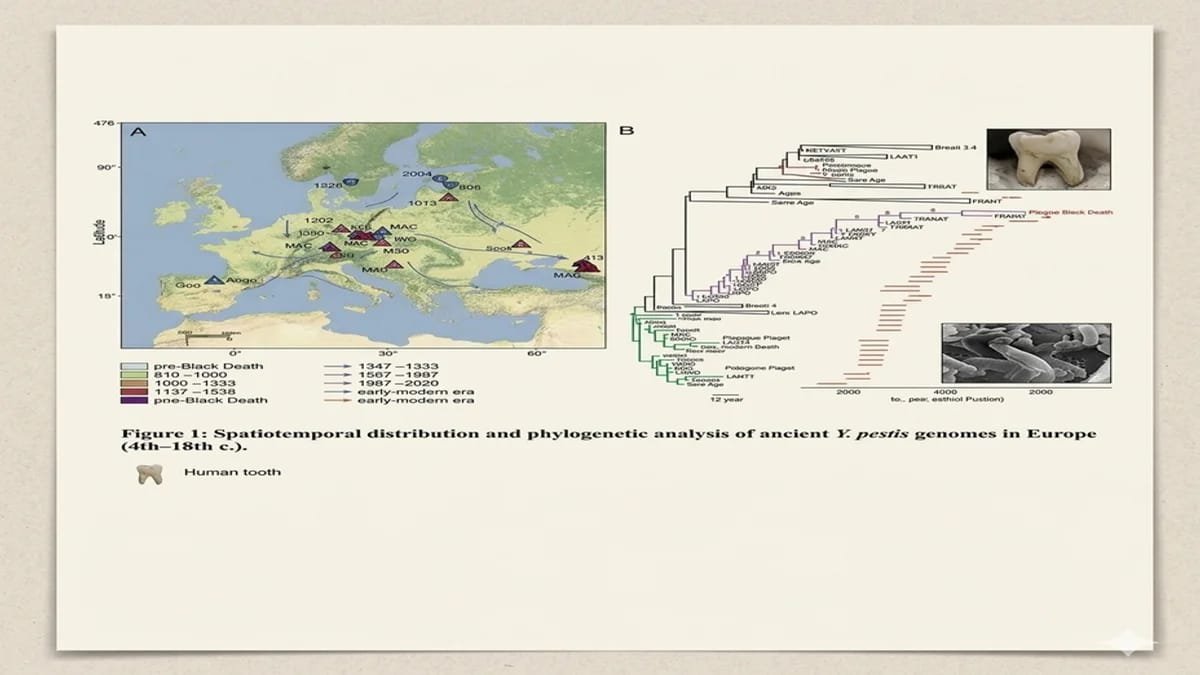
Researchers recently studied 26 ancient genomes of Yersinia pestis. These samples came from European remains dating from about 1349 to 1710. The results showed that plague returned to Europe many times after the Black Death.
This does not mean that the same outbreak lasted for 400 years. Instead, the bacterium probably survived in animals and appeared again when conditions became suitable. Some outbreaks may have started from local animals, while others may have arrived through trade, travel, or war.
Rodents were very important in the survival of plague. The bacteria could live among rodents and their fleas for long periods. This animal-based cycle is sometimes called a wildlife or sylvatic cycle. When infected fleas came close to people, they could spread the bacteria to human communities.
This may explain why plague sometimes disappeared from written records and then returned later. The disease may have been hidden in animal populations even when people were not reporting large outbreaks.
Trade and war also helped the disease spread. Ships could carry rats and fleas between ports. Soldiers and merchants travelled long distances and came into contact with many communities. Crowded towns, poor sanitation, and limited medical knowledge made it easier for the disease to spread.
The environment also affected plague transmission. Weather, rainfall, food supplies, and the number of rodents could change the size of flea and rodent populations. When there were more rodents and fleas, the chance of human infection could increase.
The plague bacterium also changed genetically over time. New genetic forms appeared as the bacteria reproduced and passed through different animal and human populations. Ancient DNA helps scientists follow these changes and understand how different plague strains were related.
The Black Death was therefore not the end of the plague. It was the beginning of a long period in which Yersinia pestis continued to return to European communities. Its history shows that diseases can survive in animals, change over time, and come back when human, environmental, and biological conditions become favourable.
The original study has been published in Proceedings of the National Academy of Sciences (PNAS). And written by Keller et.al.