
The Enormous Denisovans of Ancient Asia

For years, the Denisovans have been one of the most mysterious chapters in human evolution. Known mostly from tiny bone fragments and ancient DNA, these extinct cousins of Neanderthals and modern humans have remained shadowy figures. But new research is starting to fill in the picture, and it suggests something surprising: at least some Denisovans were enormous possibly among the tallest and heaviest humans of the Ice Age.
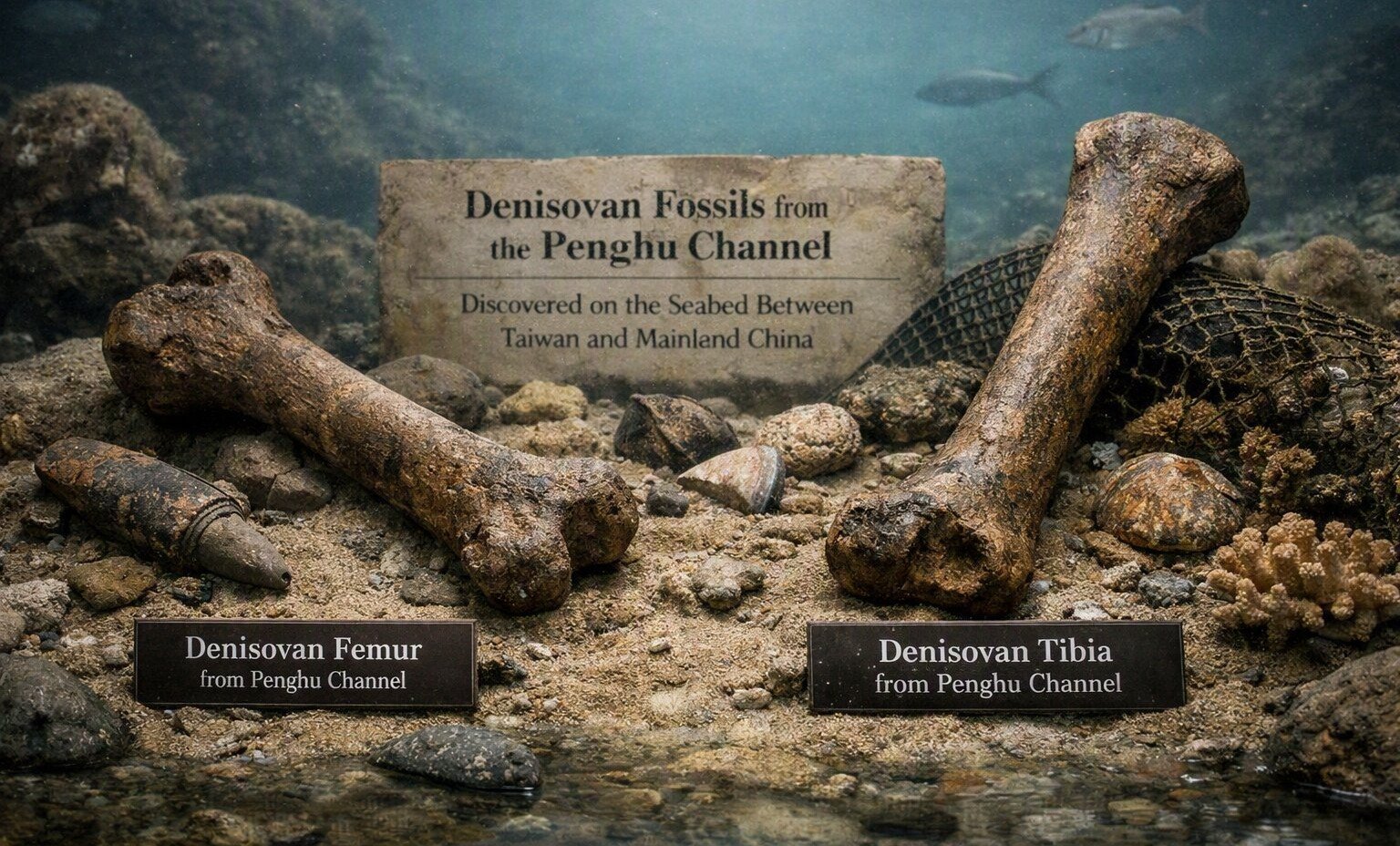
The story begins with two leg bones found on the seabed of the Penghu Channel between Taiwan and mainland China. These fossils, a thigh bone (femur) and a shin bone (tibia), were part of a larger collection donated to a museum in Taiwan over a decade ago. For a long time, scientists knew they belonged to an ancient human relative, but they weren’t sure which one.
Recent advances in protein analysis changed that. By studying ancient proteins preserved in the bones, researchers were able to identify them as Denisovan. Even more striking was their size. These are among the largest leg bones ever found from any Ice Age human, hinting at individuals who were truly massive for their time.
Based on the dimensions of these bones, scientists estimate that the two Denisovans stood approximately 180 and 190 centimeters tall, significantly taller than most humans and Neanderthals of their time. One individual, represented by the thigh bone and nicknamed Penghu 2, likely stood close to 1.8 meters (about 5 feet 11 inches) and weighed around 83 kilograms (roughly 183 pounds). The other, represented by the shin bone and called Penghu 3, may have reached about 1.9 meters (around 6 feet 3 inches) and weighed approximately 91 kilograms (about 200 pounds).
To put that in perspective, these Denisovans would have towered over many of their contemporaries. They may have been nearly a foot taller and more than 60 pounds heavier than the local Homo erectus populations that lived in the same region. Their size is comparable to the largest known Pleistocene humans from Africa and Europe, placing them at the extreme upper end of archaic human body size.
This discovery changes how we think about Denisovans. Until now, most estimates of their body size were based on limited material, like teeth and jaw fragments, which suggested they were robust but not dramatically larger than other ancient humans. The Taiwan fossils provide the first clear evidence from limb bones, showing that at least some Denisovan populations were exceptionally large.
The findings also raise new questions about human evolution. Why were these Denisovans so big? The researchers note that their large size runs counter to simple expectations from ecological rules that predict smaller bodies in warmer, lower latitude regions. This suggests that Denisovans in East Asia faced unique environmental pressures, or perhaps had a different lifestyle and diet that favored larger bodies. Some studies even suggest they consumed a lot of meat, which could have supported their massive frames.
Another interesting point is the relationship between brain size and body size. Denisovans are known to have had large brains, but part of that may simply be because their bodies were so large. This challenges earlier ideas that their brain size required a separate explanation related to intelligence.
Some headlines have sensationalized these findings, linking them to biblical giants or mythical 18 foot humans. But the actual scientific estimates are far more grounded: roughly 1.8 to 1.9 meters tall, not 5 or 6 meters. These were real, flesh and blood humans, not supernatural beings. Still, within the context of the Ice Age, they were genuinely impressive some of the biggest humans to ever walk the Earth.
The study is currently a preprint, meaning it has not yet completed full peer review, but it aligns with a growing body of evidence that Denisovans were more diverse and widespread than once thought. Future research will likely focus on finding more Denisovan fossils, especially limb bones, to confirm these size estimates and understand how much variation existed across different populations.
For now, the emerging picture is clear: The Denisovans were not just mysterious cousins in our family tree. They were a remarkable group of humans who, at least in some places and times, reached sizes that dwarfed their neighbors. As more fossils come to light, we may discover that the Ice Age was home to an even wider variety of human forms than we ever imagined.
The study was originally published as a preprint on the server bioRxiv on August 8, 2026.
Title: “Denisovan leg bones from Taiwan reveal large body size”
Authors: Yousuke Kaifu, Chun-Hsiang Chang, Yuki Tarusawa, Riko Sawafuji, Shunpei Yonemoto, Shinya Shimamura, Masato Takai, Reiko T. Kono, Chia-Hua Sun, Chih-Hsin Tsai, Minoru Yoneda, and Takumi Tsutaya
DOI: 10.64898/2026.08.07.743438
Link: https://www.biorxiv.org/content/10.64898/2026.08.07.743438v1