
Ancient DNA And Pacific Journeys

For thousands of years, people crossed the wide Pacific Ocean in canoes and settled on distant islands. Their journeys created the rich cultures, languages and traditions found across the region today. Now, new research is helping scientists understand these journeys through the study of ancient DNA.
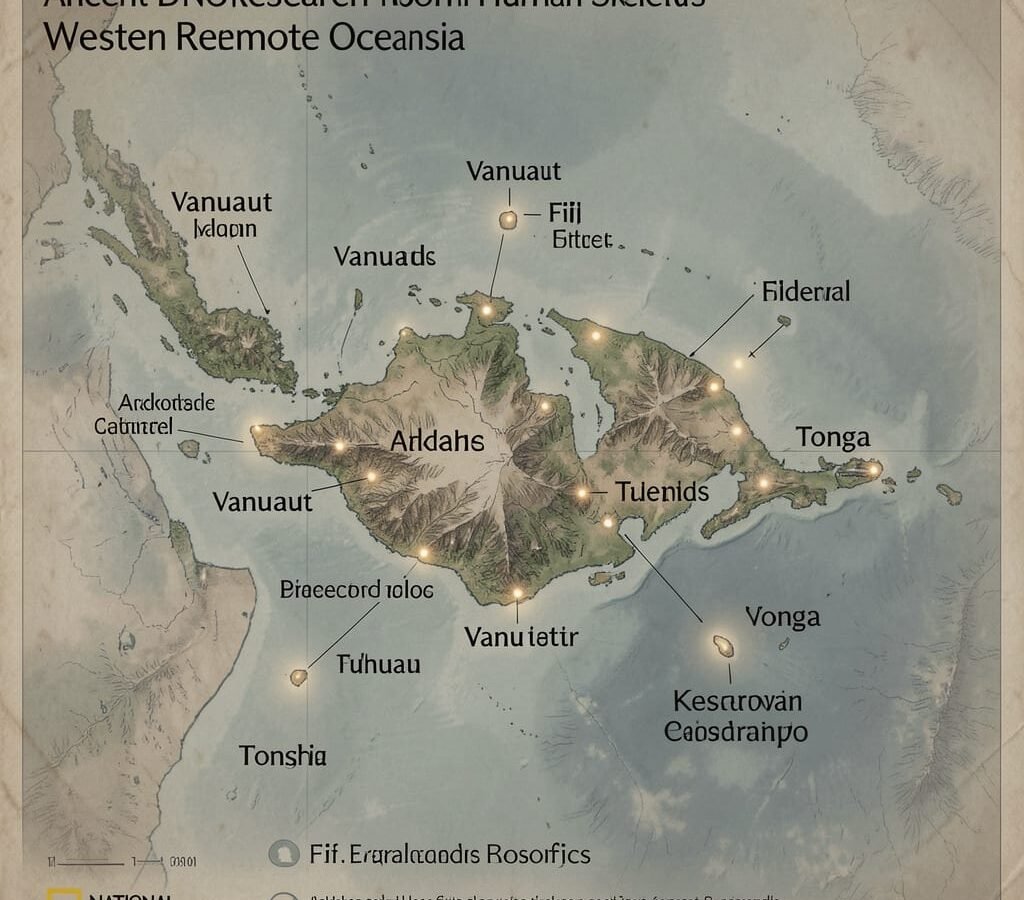
The research examined genetic material from ancient human skeletons found in western Remote Oceania. This region includes island nations such as Vanuatu, Fiji and Tonga. Some of the remains studied are around 3,000 years old, allowing researchers to investigate how people moved across the Pacific and how different communities became connected.
The settlement of the Pacific did not happen through one single migration. According to the research, different groups arrived at different times and traveled in several waves. Some people came from distant regions, while others moved between nearby islands.
When newcomers reached islands where people were already living, the groups sometimes mixed and formed families. Over many generations, these relationships created new communities with blended ancestry. In other places, communities remained more separate because of distance, geography or limited contact.
Ancient DNA helps reveal these connections more clearly than artifacts alone. Pottery, tools and buildings can show how people lived, but DNA can provide evidence about their biological relationships and movements. By comparing DNA from ancient skeletons with other ancient and modern populations, scientists can build a clearer picture of Pacific history.
The genetic evidence also supports information gathered from archaeology and language studies. Similarities in pottery styles, tools and languages suggest that Pacific communities were connected through travel and cultural exchange. The ancient DNA provides another way to understand these relationships.
At the same time, the research shows that island communities developed their own identities. Even islands that were relatively close to one another sometimes developed different languages, customs and social traditions. This diversity grew from a combination of migration, local adaptation, contact with other communities and periods of isolation.
The Pacific was therefore not an empty or disconnected space. It was a network of islands linked by skilled sailors and long-distance voyages. People carried not only their families but also their knowledge, traditions, technologies and beliefs.
The research was led by Professor Cosimo Posth of the Senckenberg Centre for Human Evolution and Palaeoenvironment at the University of Tübingen in Germany. The project involved an international team of scientists and experts from universities and research institutions in Europe and the Southwest Pacific.
The researchers brought together knowledge from several fields, including ancient DNA research, archaeology, anthropology and Pacific history. This cooperation was important because no single type of evidence can explain such a complex history on its own.
By combining genetic information with archaeological discoveries, language studies and knowledge from Pacific communities, the researchers were able to develop a broader understanding of how the region was settled.
The original scientific research was published in the journal Cell in 2026. Its title is “Ancient genomes reveal distinct human dispersals and social stratification in the settlement history of western Remote Oceania.” The study was authored by Michal Feldman and colleagues.
A report about the research was later published by Phys.org under the title “Early settlement dynamics in the Pacific revealed through ancient DNA.” The Phys.org article explained how the genetic findings are helping scientists understand the settlement of western Remote Oceania over the past 3,000 years.
Studying ancient DNA is a careful and difficult process. Researchers collect small samples from bones or teeth and examine them in special laboratories. These laboratories are designed to reduce the risk of contamination from modern DNA.
Scientists then read parts of the genetic code and compare the results with DNA from other ancient skeletons and living populations. Statistical analysis can reveal whether groups were closely related, whether they shared common ancestors and whether they mixed after meeting.
The DNA does not tell researchers every detail of the past. However, when genetic results agree with archaeological and linguistic evidence, they provide a stronger explanation of how people moved and lived.
The settlement of the Pacific was a remarkable human achievement. Early sailors traveled across large areas of open ocean without modern maps, engines or satellite navigation. They had to understand winds, waves, stars, birds and ocean currents to find their way.
After reaching new islands, they created homes and communities. Some groups continued traveling, while others stayed and developed new societies. Over time, these communities became connected through trade, marriage and cultural exchange.
The new ancient DNA research gives scientific support to this story of courage and movement. It shows that the people of the Pacific were not isolated groups with separate histories. They were part of long-lasting networks that connected islands across enormous distances.
This research is important because it gives modern people a better understanding of their ancestors and the development of Pacific societies. It also shows the value of combining modern scientific methods with archaeology and cultural knowledge.
For Pacific communities, discoveries about ancient migration can provide new information about their deep history. Genetic studies must be carried out carefully and respectfully, especially when they involve human remains and the ancestors of living people.
The findings also remind us that migration and cultural mixing are not new events. They have been part of human history for thousands of years. The Pacific is a powerful example of how people can travel, adapt, form new relationships and build communities in challenging environments.
Ancient DNA is adding new details to the history of the Pacific. It reveals that settlement happened through several movements and that different groups sometimes mixed with one another after arriving on the islands.
The work led by Professor Cosimo Posth and his international colleagues at the University of Tübingen and other institutions shows how science can uncover connections hidden in ancient bones. Published originally in Cell and later reported by Phys.org, the research gives us a deeper understanding of how western Remote Oceania became home to diverse and connected societies.
The story of the Pacific is therefore more than a story of islands. It is a story of people, journeys and relationships. Ancient DNA helps bring those forgotten journeys back into view.