
The Hidden History of Ice Age Animals

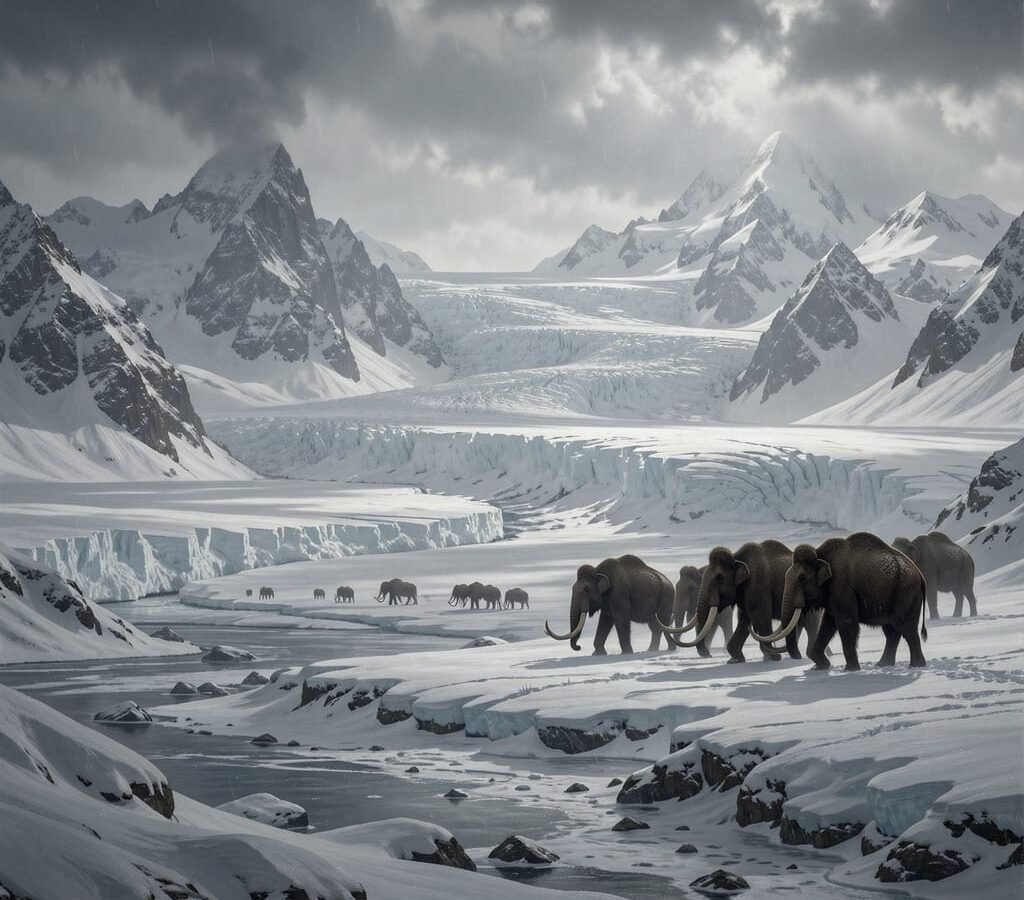
The Ice Age was a time when the Earth looked very different from today. Huge animals such as mammoths, woolly rhinoceroses, giant deer, and other extinct species lived across landscapes covered by grasslands, forests, and frozen regions. Although these animals disappeared thousands of years ago, scientists are still discovering new ways to understand how they lived. One surprising source of information is fossilized animal dung.
Ancient DNA research has transformed the study of past life. By examining genetic material preserved in old remains, scientists can identify extinct species, understand their relationships, and reconstruct parts of ancient ecosystems. DNA can sometimes survive in bones, teeth, soil, and even fossilized dung. However, recovering it is extremely challenging because ancient DNA is usually broken into very small fragments and becomes damaged over time. It can also be mixed with DNA from bacteria, plants, animals, or modern humans, making it difficult to determine which genetic material is genuinely ancient.
Dr. Selina Brace, a researcher in ancient DNA and the head of the Ancient DNA Laboratory at the Natural History Museum in London, explains how modern scientific techniques are helping researchers overcome these difficulties. In the Teach Me in 10 programme, she describes how improved DNA sequencing and targeted capture methods allow scientists to search for specific genetic fragments within highly damaged samples. These technologies make it possible to recover information that would have been lost using older methods.
Fossilized dung, also called coprolite, can provide particularly valuable evidence. When an animal eats, traces of plants, animals, and microorganisms pass through its digestive system. If the dung is preserved under suitable conditions, some of this biological material can remain trapped inside it for thousands of years. Scientists can then examine the sample to learn what the animal ate and what other living organisms were present in its surroundings.
This evidence can reveal much more than an animal’s diet. If researchers find DNA from particular plants, they can learn about the vegetation that grew in the area. DNA from insects, parasites, or other animals can provide clues about the wider ecosystem. By comparing samples from different places and time periods, scientists can also study changes in climate, vegetation, animal movement, and food availability.
Fossilized dung may even help researchers understand how ancient animals interacted with their environment. For example, the remains of certain plants in a large herbivore’s dung could show whether it lived mainly in open grasslands or near wooded areas. Differences in diet over time might indicate that the climate was changing or that the animal had moved to a new region. In this way, a single preserved sample can act like a small record of both an animal’s life and its surroundings.
The study of fossilized poop also demonstrates that important scientific evidence is not always found in impressive objects such as bones or tusks. Fragile and unexpected materials can preserve information that other remains do not. Dung may contain direct evidence of what an animal consumed, while bones can tell scientists about its body but not always about its daily diet or the plants growing nearby.
Despite these advantages, researchers must examine ancient DNA with great care. Contamination is a serious concern, and scientists need strict laboratory procedures to ensure that modern DNA does not enter the samples. They also compare genetic results with archaeological, geological, and environmental evidence. This helps them confirm that their conclusions are reliable rather than based on a single uncertain clue.
The study of fossilized dung is therefore opening a new window into the Ice Age. Through advanced DNA technology, scientists can investigate the diets of extinct animals, identify ancient plants and species, and reconstruct ecosystems that vanished long ago. What may appear to be ordinary waste is, in fact, a valuable time capsule containing information about life on Earth thousands of years in the past.