
Brazil’s First Ancient DNA Lab Turns to a Colonial Cemetery in Amapá

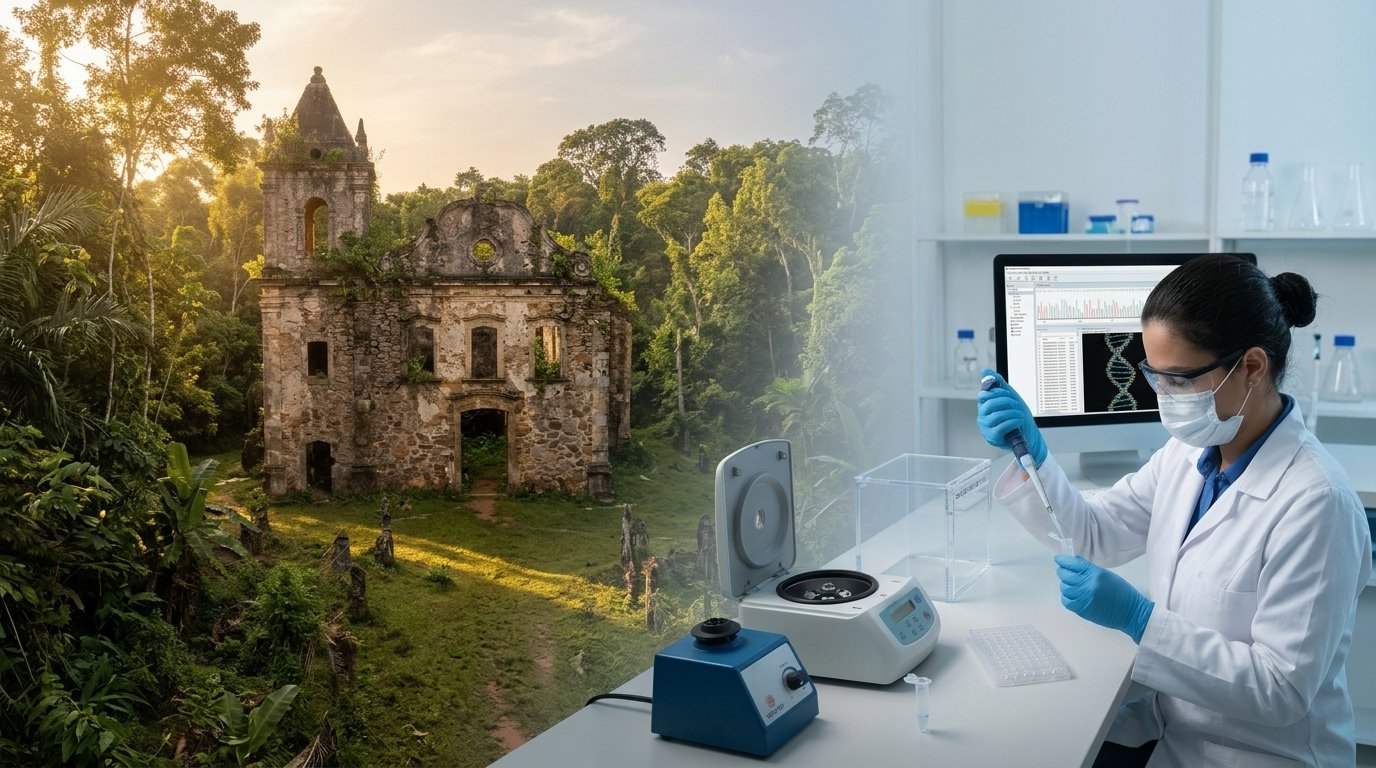
Brazil now has its first laboratory fully dedicated to ancient DNA research. Based at the University of São Paulo’s Museum of Archaeology and Ethnology (MAE-USP), it will study DNA from old human remains in Brazil and aims to reduce the country’s dependence on laboratories in North America and Europe.
The laboratory’s first major project studies human bones from Mazagão Velho, in the state of Amapá. Researchers want to know whether the people buried near an old colonial church were only Portuguese settlers or whether they also included enslaved and free African people brought to Brazil through the Atlantic slave trade.
Ancient DNA is genetic material recovered from bones, teeth, or other remains that may be hundreds or thousands of years old. Scientists can use it to look for clues about a person’s genetic ancestry, family relationships, population history, and sometimes inherited biological traits.
The new facility is designed to complete the main steps of ancient DNA work in Brazil, extracting DNA from remains, preparing it for sequencing, analyzing the genetic data, and storing the results. This is important because, in the past, samples from Latin America were often sent abroad, where the data and expertise remained outside the region.
The project is led by researchers connected to USP’s Laboratory of Archaeology and Environmental and Evolutionary Anthropology (LAAAE), including archaeologist Marcony Alves and archaeology master’s student Luana Nicolau. Their goal is to build local scientific capacity and create partnerships across Latin America rather than sending Brazilian heritage overseas for study.
Mazagão Velho began as a colonial settlement in 1770. Portuguese authorities moved people from Mazagão, a Portuguese held town in Morocco, to Amapá after conflict in Morocco. The group included Portuguese settlers and enslaved Black people.
The settlement faced severe problems in the Amazon, unfamiliar environmental conditions, disease outbreaks, isolation, and limited support from colonial authorities. Over time, many Portuguese residents left or died, while Black, Indigenous, and mixed-ancestry communities became central to the area’s population and culture.
Between 2004 and 2006, archaeologists from the Federal University of Pernambuco excavated the ruins of the Old Church site. They found the remains of a building measuring about 13 by 40 meters and discovered dozens of burials beneath the church floor, around its foundations, and nearby.
The researchers have sampled remains from 63 individuals. Their work combines ancient DNA with other biological evidence, especially strontium isotopes found in tooth enamel.
Strontium isotopes can provide information about where a person lived during childhood. Different landscapes contain different strontium signatures, which enter food and water and become part of developing teeth. By comparing these signatures with local and regional reference values, scientists may be able to tell whether someone grew up in Morocco, Sub Saharan Africa, or the Amazon region.
Ancient DNA can add another line of evidence. It may help researchers estimate genetic ancestry and identify biological relationships among buried individuals. Together, DNA and isotope evidence can test whether the cemetery contained only people of Portuguese origin, or a more diverse population.
Researchers identified at least one individual with intentional dental modification. This practice of changing the shape or appearance of teeth for cultural or ritual reasons is known in several Sub Saharan African populations, but it was not traditionally practiced by Europeans or Amazonian Indigenous groups.
That finding does not by itself prove that the person was African or enslaved. However, it gives researchers a biological clue that supports the community’s question: were some people buried inside the church part of the African diaspora rather than the Portuguese elite?
The official story has often described the cemetery as belonging to Portuguese people from Morocco. But objects found with the remains including medals, ceramics, and plastic buttons suggest that burials continued there after the eighteenth century. Plastic buttons, in particular, indicate use in much more recent periods.
This means the site may not represent one single colonial community. It may contain people buried at different times, with different social positions and ancestral backgrounds.
For local residents, the question is deeply personal. In a colonial society that placed Portuguese people above Black and Indigenous people, being buried inside the church could signal social status. Community members want to know whether Black individuals were buried there, and the new research may help answer that question using biological evidence.
This story was reported by Jornal da USP on November 25, 2026, in the article “Genetic sovereignty in archaeology inspired the creation of the first ancient DNA laboratory in Brazil.” The article identifies Marcony Alves, a postdoctoral researcher at USP’s Institute of Biosciences, and Luana Nicolau, a master’s student in archaeology, as key researchers discussing the Mazagão Velho project.
The Mazagão Velho DNA and isotope results appear to be preliminary research findings, not yet a final peer-reviewed journal publication. The USP report describes ongoing analyses and early observations, such as the dental modification and the 63 sampled individuals, rather than a completed study with a journal name, publication date, and full author list.
This project shows how biology can help correct historical silences. Written records from colonial Brazil often focused on Portuguese authorities and settlers, while giving little attention to enslaved Africans, free Black communities, and Indigenous peoples.
Ancient DNA cannot replace community memory or historical research. But when used carefully with consent, respect for ancestral remains, and collaboration with local people it can provide evidence about who was present, where they came from, and how colonial society actually lived.
For Mazagão Velho, the bones may help reveal a more complete history: not simply the story of Portuguese settlers from Morocco, but also the lives of African diasporic people and Indigenous communities who helped shape the region.