
How Parchment DNA Is Revealing History

For hundreds of years, old manuscripts have preserved the ideas, stories, laws, and beliefs of different societies. Today, scientists have discovered that these manuscripts contain another type of history. Their DNA can provide information about the animals whose skin was used to make the parchment.
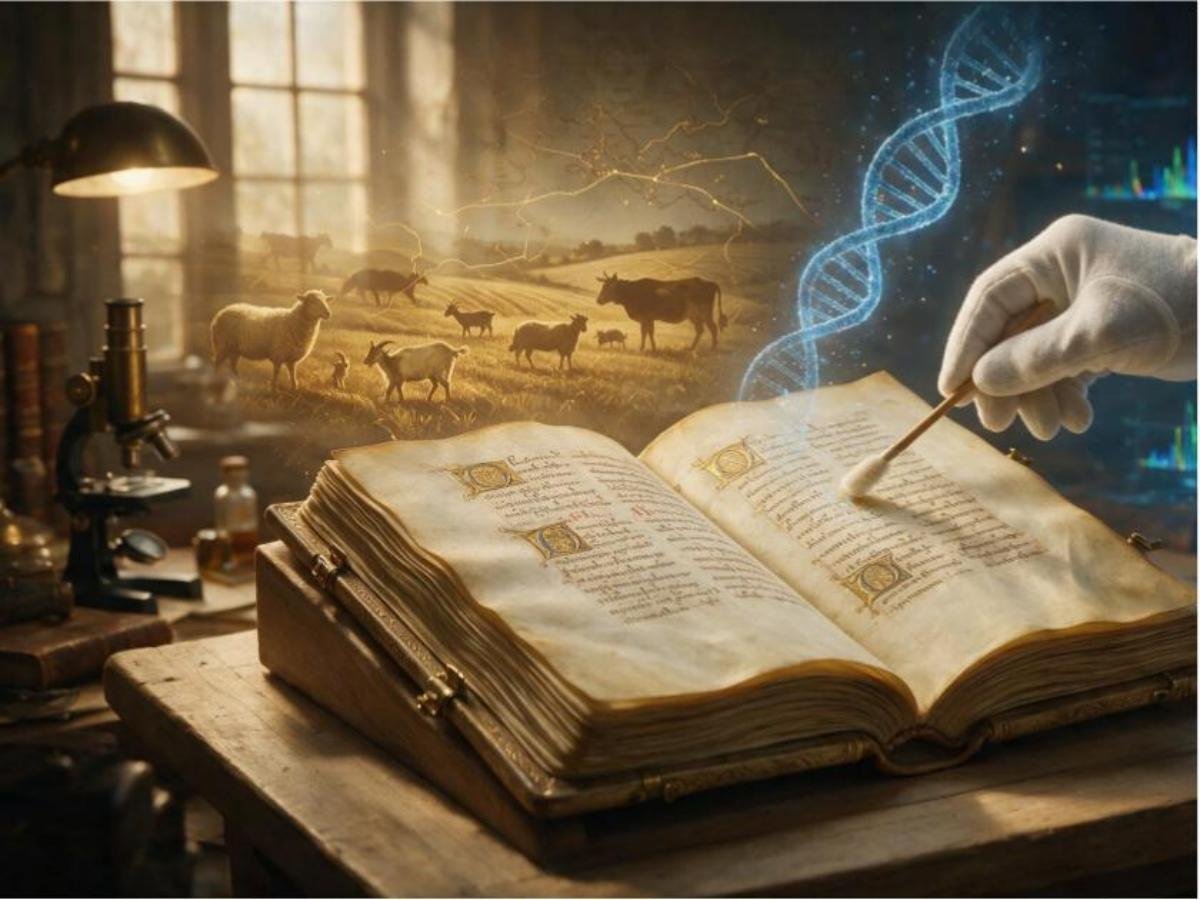
Parchment is made from animal skin. Sheep, goats, and cattle were commonly used for this purpose. The skin was cleaned, stretched, and dried before people wrote on it. Because parchment comes from animals, it can still contain small traces of their genetic material, even after many centuries.
In the past, scientists usually had to cut a small piece from a manuscript to study its DNA. This was a problem because many manuscripts are rare, fragile, and extremely valuable. Cutting them could cause permanent damage. The new method allows researchers to collect DNA without harming the manuscript.
Scientists use a soft brush to gently collect tiny cells and particles from the surface of the parchment. This brush is similar to the type of brush used in some medical tests. The collected material is then taken to a laboratory, where scientists extract and study the DNA.
The researchers can use this DNA to discover which animal was used to make the parchment. They may also learn whether the animal came from the local area or from another region. This can help historians understand ancient trade routes, farming methods, livestock breeds, and the movement of animals between different places.
In one important study, researchers examined 91 manuscripts kept at Duke University’s Rubenstein Library. These manuscripts came from areas between England and Ethiopia and were written between the late eighth century and the early twentieth century. Together, they provided information covering about 1,300 years of history.
The DNA found in the parchment may answer many historical questions. It can show whether sheep, goats, or cattle were used to make a document. It can also provide clues about how people raised animals, how livestock changed over time, and how animal products were transported from one region to another.
This method is especially valuable because it protects historical documents. Libraries, museums, and archives can allow scientists to study their collections without cutting or damaging them. As a result, researchers may be able to examine many more manuscripts than before.
However, scientists must study the results carefully. Parchment can also contain DNA from people who touched it, insects, microorganisms, or materials used during repairs. For this reason, DNA results must be compared with handwriting, historical records, archaeology, and other forms of research.
This new research shows that a manuscript is more than just a collection of written pages. It is also a physical record of the past. The words written on it tell us what people wanted to communicate, while the DNA may tell us about the animals, farmers, traders, and communities connected to its creation.
Nondestructive DNA testing is opening a new way to study history. It allows scientists to discover hidden information from ancient manuscripts while protecting these precious documents for future generations. In this way, parchment is helping researchers understand not only what people wrote 1,300 years ago, but also how they lived and worked.
The study was originally published in Manuscript Studies: A Journal of the Schoenberg Institute for Manuscript Studies in 2026.
Its title is “Adventures in the Animal Archive: New Techniques for the Genetic Analysis of Parchment Manuscripts.” The study was written by Timothy L. Stinson and other researchers. It has the DOI 10.1353/mns.2026.a990234.